


The Testing Team Didn't Die - It Became the Most Important Engineering Role in AI
Developers used to look down on the testing team. In the AI era, evaluation engineers are the ones deciding whether your product is safe to ship. Here's why AI evals are fundamentally different from software testing - and the tools doing it right.
There's an old joke in software companies. The developer pushes code on Friday afternoon and disappears. The testing team sweats through the weekend. Monday morning, the developer walks in, looks at the bug list, and says: "Works on my machine."
That joke is now extinct.
Not because developers became more careful. But because the entire nature of what "working" means has changed - and a new discipline has stepped in to define it.
We used to call them QA engineers, or testers. Today, the most forward-thinking teams call them evaluation engineers or AI evals leads. And in a world where your product is powered by a large language model, they are not just catching bugs - they are the last line of defense between a hallucinating AI and a paying customer.
This is the story of how that shift happened, what AI evaluation actually is, and the tools doing the heavy lifting right now.
Testing vs. Evaluation: Not the Same Thing
Let me be direct about this, because the confusion is costing teams real money.
Traditional software testing is deterministic. You write a function. You write a test. You assert that add(2, 3) returns 5. Either it does, or your CI pipeline turns red. The inputs are fixed. The outputs are fixed. Pass or fail - nothing in between.
AI evaluation is probabilistic. There is no "correct" output. You ask an LLM "explain cloud computing to a 10-year-old." Every run returns something different. Both might be excellent. One might be confusing. One might contain a subtle factual error. None of them are "wrong" in the way a failed unit test is wrong.
This fundamental difference breaks every traditional testing assumption:
| Traditional Testing | AI Evaluation |
|---|---|
| Deterministic outputs | Probabilistic outputs |
| Binary: pass/fail | Continuous: scored 0–1 or rated |
| Tests run once, result is fixed | Same test, different results each run |
| Asserts exact values | Asserts quality dimensions |
| CI catches regressions | Eval loops catch behavioral drift |
| Written by devs | Designed by domain experts |
When your team treats AI evaluation like traditional testing, they build false confidence. "All tests pass" in an LLM application tells you almost nothing about whether the product is actually good.
What AI Eval Actually Measures
AI evaluation doesn't ask "did the function return the right value?" It asks questions like:
- Faithfulness: Is this answer grounded in the source document, or did the model hallucinate?
- Relevance: Does this response actually address what the user asked?
- Toxicity: Did the model produce harmful, biased, or inappropriate content?
- Helpfulness: Would a real user find this response useful?
- Completeness: Did the agent cover all parts of the question, or did it miss something important?
- Latency vs. quality trade-off: At what response time does quality degrade?
These are not things you can assert with expect(output).toBe("..."). They require judgment - either from humans, or increasingly, from another model acting as a judge.
That last sentence is the key insight of modern AI evals: you use AI to evaluate AI. This is called LLM-as-a-Judge, and it has become one of the dominant patterns in the field.
The Evaluation Loop: Offline and Online
Good eval infrastructure operates in two modes simultaneously.
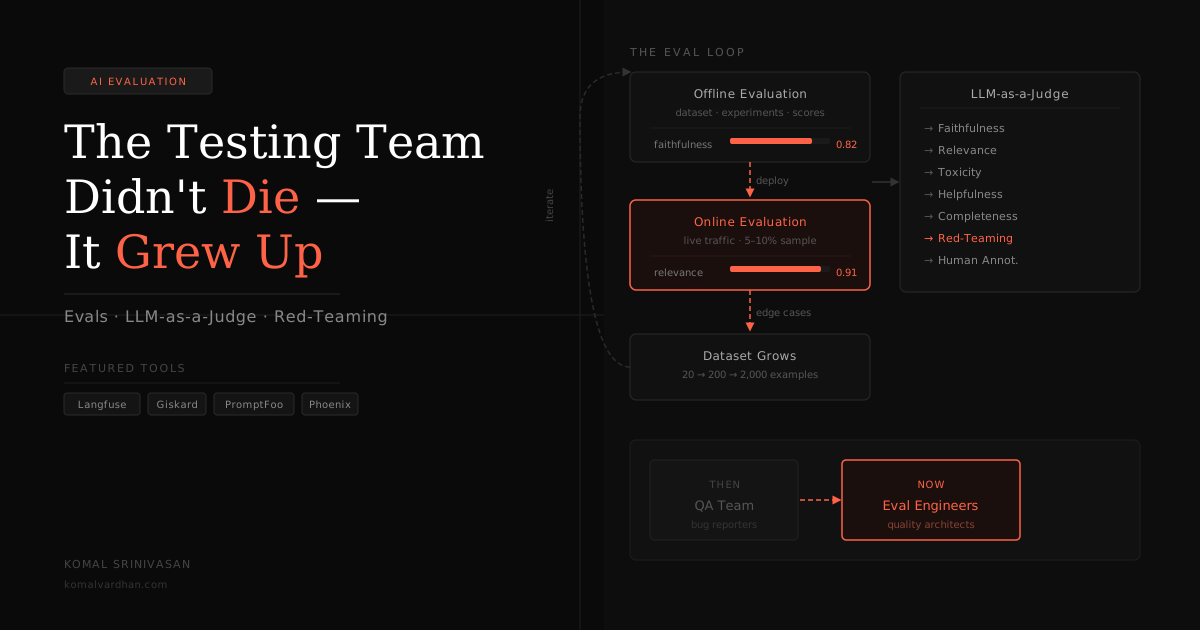
Offline evaluation runs before you deploy. You maintain a dataset of representative inputs - customer questions, edge cases, things that went wrong in production last month. Every time you change a prompt, update a model version, or tweak retrieval logic, you run your eval suite against this dataset. You get scores. You compare. You decide if the change is safe to ship.
This is the AI equivalent of a test suite in CI. Except instead of assert output == expected, you're running a rubric-guided judgment: "Is this response more helpful than the previous one? Did hallucination frequency increase?"
Online evaluation runs in production. A sample of real user interactions - 5%, 10%, whatever your cost tolerance allows - gets evaluated in real time against your live evaluators. This is how you catch the things your dataset didn't cover. The French customer who asked in French and got an English response. The edge case no one thought to add to the test dataset.
When you find those edge cases in production, you add them to your offline dataset. The loop closes. Your dataset grows from 20 examples to 200 to 2,000 - each one a real failure mode, now defended against.
The Tools Doing This Work Today
Langfuse - Evaluation Infrastructure for Production Teams
Langfuse is the most complete platform for LLM observability and evaluation. It handles the full loop: tracing every LLM call in production, running evaluators against live traffic, managing datasets and experiment runs, and storing scores for comparison.
What makes Langfuse stand out is its evaluation architecture. You can run evaluation at three levels:
- Observation-level: Score individual LLM calls, retrieval steps, or tool calls - not the full workflow. This is dramatically faster and more precise than trace-level evaluation.
- Trace-level: Evaluate full multi-step workflows where context from every step matters.
- Experiment runs: Controlled offline evaluation against fixed datasets, with side-by-side comparison of runs.
Langfuse supports LLM-as-a-Judge natively - a managed evaluator catalog covering hallucination, relevance, toxicity, and helpfulness, built on rubric-guided scoring. Strong LLM judges (GPT-4o class models) achieve 80–90% agreement with human annotators, comparable to inter-annotator agreement between humans.
They also support human annotation queues - structured workflows where your team can review flagged outputs, build ground truth, and feed labels back into the evaluation pipeline.
For teams building on RAG architectures, Langfuse integrates directly with RAGAS - the industry-standard library for measuring faithfulness, context precision, and answer relevance in retrieval-augmented generation.
If I had to recommend one platform for a team moving from zero eval infrastructure to production-grade evals, it's Langfuse. The observability and evaluation surfaces are unified, which means you're not stitching together three different tools.
Arize Phoenix - Open-Source Traces and Evals for AI Engineers
Arize Phoenix is an open-source AI observability platform built for engineers who want full control of their stack. It provides real-time tracing of LLM applications - every prompt, every completion, every retrieval, every tool call - with a visual interface for exploring what your model is actually doing.
Phoenix's strength is its depth for developers. You get:
- Span-level tracing with full input/output capture at every step of an agentic pipeline
- Embedding visualizations that let you see where your model is clustering semantically - useful for finding distribution drift in retrieval systems
- Eval templates for common dimensions: hallucinations, relevance, toxicity, Q&A correctness
- A/B comparison of prompt versions on historical data
- OpenTelemetry compatibility - it speaks the same instrumentation protocol as your existing observability stack
Phoenix is particularly well-suited to teams with data scientists embedded in product teams. The ability to explore embeddings visually, run custom eval functions, and slice trace data by metadata makes it a strong choice when your eval work is research-heavy and you need flexibility over SaaS convenience.
It runs locally or self-hosted - no cloud dependency, no data leaves your infrastructure.
Giskard - Red-Teaming and Risk Testing for LLM Products
Giskard approaches evaluation from a risk and safety angle. Where Langfuse and Phoenix help you measure quality over time, Giskard helps you find failure modes before they reach users.
The core concept is LLM red-teaming: systematically probing your model for vulnerabilities - jailbreaks, prompt injections, hallucinations on specific domains, demographic bias, off-topic drift. Giskard automates the generation of adversarial test cases targeted at your specific model and use case.
For teams building customer-facing AI products in regulated industries - finance, healthcare, legal - this kind of structured risk testing is not optional. It's due diligence. Giskard creates an audit trail: here is what we tested, here is what the model did, here is where it failed, here is what we fixed.
Giskard also integrates into CI/CD pipelines, so adversarial test suites run on every deployment - not just before launch.
The mental model shift Giskard represents is important: evaluation is not just about quality - it's about risk. A model can score highly on helpfulness and relevance and still catastrophically fail when a user crafts a specific input. Red-teaming finds those inputs before your users do.
PromptFoo - Developer-First Prompt Testing in CI
PromptFoo is built for the moment a developer wants to test a prompt change without spinning up an entire evaluation platform. It's an open-source CLI and configuration-driven tool for running structured prompt evaluations locally and in CI.
The core workflow: define your test cases in YAML or JSON. Define your assertions - either exact string matches, regex patterns, or LLM-graded judgments. Run promptfoo eval. Get a score table. Compare against previous runs.
What PromptFoo does exceptionally well:
- Provider-agnostic: Test the same prompts against OpenAI, Anthropic, Mistral, local models, or your own API endpoints - side by side
- Red-team mode: Automatically generate adversarial inputs to find edge cases in your prompts
- CI integration: Runs in GitHub Actions, GitLab CI, or any CI environment - fails the build if eval scores drop below a threshold
- Fast iteration: No platform setup required. Write a YAML file, run the CLI, see results in seconds
PromptFoo is where individual developers and small teams start their eval journey. It's the simplest path from "I think this prompt is better" to "I have data that proves this prompt is better." Once you're running evals in CI for every prompt change, you've crossed the threshold from guessing to engineering.
The Rise of the Evaluation Engineer
Here's the cultural shift that most people in software haven't fully processed yet.
In traditional software development, testers were support staff. Developers designed the system. Developers wrote the code. Testers checked that the code matched a spec. The developer was the craftsperson; the tester was the inspector.
This hierarchy was already breaking down before AI - the DevOps movement, the rise of TDD, embedded QA in Agile teams - but it never fully inverted.
AI inverted it.
When your product is a language model, the "code" is a prompt, a retrieval strategy, a fine-tuned model, and a chain of function calls. The developer can ship all of that in a day. But whether that product is actually safe, reliable, honest, and useful? That requires a completely different skillset.
It requires someone who understands the business domain deeply enough to write evaluation rubrics that match real quality. It requires someone who can design adversarial test cases that expose failure modes before users find them. It requires someone who can read a score distribution and say "this drop in faithfulness score at the tail is a hallucination problem, not a relevance problem."
That person is not the person who wrote the prompt. That's a specialization.
The teams getting this right have stopped calling these roles "QA" or "testing" altogether. They're evaluation engineers, AI quality leads, or evals researchers. Their output is not a test report. It's a dataset, an eval pipeline, a rubric library, and a dashboard that tracks quality over time.
And here's the uncomfortable truth for developers: in an AI-powered product, the evaluation engineer has more leverage over product quality than the developer does. A developer can ship a new feature. An evaluation engineer decides whether that feature is safe to exist.
The old joke about the developer who disappears on Friday? The evaluation engineer is the one who answers the question the developer never asked: not "does it run?" but "does it work, for real users, in the ways that matter?"
That is not a support function. That is a product function. And the teams that understand this distinction are shipping AI products that don't embarrass them in public.
Practical Starting Points
If your team is new to AI evaluation, here's a concrete path:
Week 1 - Instrument: Add Langfuse or Phoenix tracing to your LLM application. Every prompt and response should be logged. You cannot evaluate what you cannot see.
Week 2 - Score: Set up one LLM-as-a-Judge evaluator on your most critical output (the final response to the user). Measure helpfulness and relevance on a 5% sample of production traffic.
Week 3 - Dataset: Export 50 representative examples from production - a mix of typical cases, edge cases, and any known failure modes. This is your first eval dataset.
Week 4 - Offline loop: Run PromptFoo or Langfuse experiments against your dataset before your next prompt change. Compare scores. Make the "this prompt is better" claim quantitative.
Month 2 - Red-team: Use Giskard to generate adversarial test cases for your use case. Run them. Find out what breaks. Fix it.
By the end of month 2, you have evaluation infrastructure. You're no longer guessing. You're engineering.
Why This Matters Now, Not Later
Every team building on LLMs is accumulating evaluation debt. Decisions made today without evals - prompt changes, model upgrades, retrieval tuning - are bets without data. Some of those bets are paying off. Some are degrading quality in ways nobody has measured yet.
The teams that build evaluation infrastructure early have a compounding advantage. Their dataset grows with production traffic. Their evaluators get calibrated against real failure modes. Their developers can ship changes with confidence instead of anxiety.
The teams that skip evals are flying blind. They'll find out eventually - from an embarrassing product failure, a user complaint that goes viral, or a model upgrade that silently broke half their use cases without anyone noticing.
AI evaluation is not a nice-to-have layer on top of AI development. It is the thing that separates AI products that hold up from AI products that don't.
The testing team didn't go away. It got evolved. Like from a cocoon to Butterfly.
I write about building serious AI products - architecture, evals, observability, and the engineering decisions that matter. If this was useful, the next piece is worth reading too.